
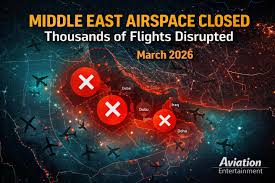

Dubai International (DXB) handles roughly 454,000 flights a year and connects passengers to 110 countries, yet recent Middle East airspace closures forced large-scale reroutes and temporary suspensions across Dubai, Abu Dhabi and Doha, displacing tens of thousands of travellers and testing ground handling, crew rotations and airport resilience at very short notice.
Immediate operational fallout at a glance
When regional airspace closed, airlines had to re‑plan long-haul sectors, cancel or delay flights, and reposition crews. Ground operations at Dubai faced an urgent surge in passenger care needs: hotel re-accommodation, baggage handling backlogs, enhanced security screening of diverted aircraft, and rapid changes to slot allocations at alternate airports. That combination strained both terminal capacity and local transfer services.
Key pressures on airport logistics
- Passenger displacement: large volumes of inbound travellers needing onward connections or local accommodation.
- Fleet positioning: aircraft out of place for scheduled rotations, affecting maintenance and crew duty times.
- Slot and air traffic control: cascading delays at nearby alternate hubs as traffic patterns changed.
- Surface transport demand: spikes in taxi and private transfer bookings to and from hotels and alternate airports.
Recovery tasks and timelines
Restoring the network involved three parallel tracks: rerouting and rebooking passengers, restoring scheduled frequencies, and stabilising workforce logistics. Airlines with deep hub connectivity were able to prioritise transit flows versus origin-destination traffic; Dubai, where roughly half the airport’s passengers are destined for the city itself, had the extra task of protecting destination demand while reopening transit lanes.
Operational measures commonly deployed
- Use of charter or ad-hoc flights to clear backlogs.
- Temporary reallocation of staff and resources between terminals.
- Commercial incentives—promotional fares or flexible rebooking—to attract stranded passengers back once service resumes.
Competitive landscape: why geography and aircraft tech matter
The Gulf hubs’ geographic advantage remains significant: about one third of the world’s population sits within a four‑hour flight from Dubai. However, competitors are progressing on multiple fronts. Turkish Airlines’ Istanbul hub sits outside the conflict zone and can pick up rerouted transit traffic; Saudi and Indian carriers are also expanding their networks. Meanwhile, developments like ultra‑long‑range aircraft (for example, Airbus’ A350 variants supporting point-to-point routes such as Qantas’ Sydney‑London project) can erode hub-dependent transfer volumes by enabling more direct nonstop services.
| Strength | Gulf hubs | Emerging challengers |
|---|---|---|
| Geographic reach | One‑stop access to many regions | Growing long‑haul networks and more direct routes |
| Network power | High frequency and connectivity | Rapid expansion of slots and alliances |
| Resilience | Proven recovery after past shocks | Lower exposure to regional instability |
What passengers and local transport providers should expect
- Short-term shifts toward more direct flights where available.
- Increased demand for airport transfers, private cars and last‑mile services during recovery phases.
- Temporary price volatility for taxis, limousines and private hire as supply and demand rebalance.
Implications for taxis and transfer services
Hub disruptions tend to boost short-term demand for reliable transfer options: stranded travellers need immediate rides, families may require larger vehicles, and corporate passengers often seek guaranteed, metered services with vetted drivers. This increases the value of transparent listings showing vehicle make, model and driver ratings so passengers can choose exactly the right car for airport pickups or rebooked connections.
How booking platforms can help
Clear information on vehicle capacity (2‑, 4‑, 6‑seater, private limousine), exact pickup locations, and fare breakdowns reduces stress during network outages. Platforms that allow travellers to view the car, driver license verification and reviews in advance create trust when timing and baggage needs are critical.
Highlights: the episode underscores the importance of hub flexibility, the rising appeal of direct long‑haul services, and the value of on‑ground transfer reliability. Still, even the best reviews and the most honest feedback can’t truly compare to personal experience. On LocalsRide, you can hire a car with driver from verified providers at reasonable prices. This empowers you to make the most informed decision without unnecessary expenses or disappointments. Start planning your next adventure and secure your worldwide transfer with LocalsRide. Book your Ride LocalsRide.com
In summary, the recent airspace closures showed both the strategic strength and the vulnerability of Gulf hubs: they retain unmatched connectivity and aggregation power, but disruptions can shift traveller behaviour toward direct flights and alternative routing, with immediate knock‑on effects on taxi, cab and private transfer demand. For travellers, having an exact, reliable transfer service matters more than ever—whether you need a private car, a 6‑seater, a limousine or a cheap cab to the airport. LocalsRide.com supports this need by offering transparent listings of vehicle, driver and fare details so you can book with confidence, get the best price and know exactly what service to expect at your destination.