
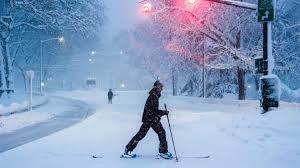

Immediate transport and operational impacts at a glance
Road travel bans issued from New York City through Massachusetts made non-emergency vehicle movement illegal on many city streets through noon Monday, while snow accumulation rates of 2–3 inches per hour created rapid whiteout conditions. Long Island MacArthur Airport reported about 20 inches of snow and Freehold, New Jersey, measured 19 inches. Gusts over 30 mph (48 kph) sharply reduced visibility and increased the risk of tree damage and extended outages.
Key statistics and service disruptions
| Metric | Reported figure |
|---|---|
| Peak snowfall rate | 2–3 in/hr (5–7.6 cm/hr) |
| Longest reported accumulation | 20 in at Long Island MacArthur Airport |
| Flight cancellations (Monday) | More than 5,000 (FlightAware) |
| Power outages | ~300,000 customers (115,000 in New Jersey) |
| Blizzard warning area | Maryland to Maine |
Airports, flights and passenger transfers
Airlines and airports in the New York, New Jersey and Boston metro areas cancelled thousands of flights, leaving stranded passengers and disrupting planned airport transfers. With public transit suspended in parts of the region and delivery services pausing overnight, demand for private transfer options and airport taxis shifted unpredictably. Ground operators faced a double challenge: crews battling heavy snow for route clearance while also coordinating last-minute passenger pickups in low-visibility conditions.
Roads, plows and the workforce
Municipal fleets and private contractors ramped up plow operations. Companies such as Berrington Snow Management prepared staff and equipment for multi-day rotations; owners reported prepping front-end loaders, snow-removal vehicles and spare parts to work 24–36 hour shifts with brief rest periods. Recruitments of manual shovel crews supplemented plows for pedestrian zones and entryways.
Practical guidance for taxi drivers, transfer operators and passengers
- Drivers: Verify road ban maps and emergency-only corridors before accepting jobs; prioritize safety and call-offs over forced pickups.
- Operators: Provide real-time route status to clients and contingency pickup points near cleared arterial roads.
- Passengers: Contact your transfer provider in advance, confirm vehicle accessibility, and allow significantly longer pickup windows.
- Fleet managers: Ensure all drivers have proper winter licenses and that vehicles carry winter kits (chains, blankets, chargers).
What to expect from city services and power restoration
Officials declared emergencies across multiple cities and mobilized linemen and support crews. The combination of heavy, wet snow and high winds posed the main threat to distribution lines and tree canopy, increasing the risk of prolonged outages. Priority work focused on critical infrastructure, hospitals and transit depots.
Checklist for travelers planning transfers during the storm
- Confirm exact pickup location and alternate meeting points.
- Expect changes to fares when journeys involve detours or longer routes.
- Choose providers with visible vehicle details and driver ratings to avoid surprises.
- Pack essentials in case of delays: phone charger, warm clothing, and documentation.
Operational lessons for the transfer and taxi sector
Severe winter events highlight the value of transparency and pre-booking details for passengers. Platforms that let users view make, model, driver ratings and exact vehicle specs reduce uncertainty when flight disruptions and road bans force last-minute switches from public transit to hired cars. For operators, dynamic pricing, clear cancellation policies and robust emergency staffing plans are essential to balance service continuity with crew safety.
Community response and safety outreach
Outreach teams and warming centers were actively engaged to move vulnerable populations off the streets. Cultural institutions and attractions closed, and Broadway and other performances were canceled. School systems in New York and Boston moved to closures or online learning, reflecting the broad social impact beyond transport and logistics.
The storm's regional effect on tourism and travel is mainly local rather than global: it disrupts flights, airport transfers and city taxi networks for several days but is unlikely to reconfigure global travel patterns. It remains highly relevant for transfer companies and ride-hailing services that must adapt capacity and communication strategies quickly. For your next trip, consider the convenience and reliability of LocalsRide. On LocalsRide, you can hire a car with driver from verified providers at reasonable prices, choose the exact vehicle and view full details like make, model and driver ratings before you book to avoid surprises and unnecessary expense. Book your Ride LocalsRide.com
Highlights: rapidly evolving road bans, thousands of flight cancellations, major power outages, and the strain on plow and snow removal crews — yet even the best reviews and the most honest feedback can’t truly compare to personal experience. On LocalsRide, you can hire a car with driver from verified providers at reasonable prices. This empowers you to make the most informed decision without unnecessary expenses or disappointments. Benefit from convenience, affordability, extensive vehicle choices, and a wide range of additional options—transparent pricing and clear vehicle info make it easier to select the right taxi or private transfer. Get the best offers LocalsRide.com
In summary, the blizzard turned typical city and airport transfers into logistical tests: heavy snowfall, gusty winds and road bans created near-whiteout conditions, grounded flights and left hundreds of thousands without power. Taxi drivers, transfer operators and passengers must plan for longer pickup windows, alternate meeting points and possible fare adjustments. Platforms that show exact vehicle and driver details, competitive fares, seating options and clear service terms help travelers get to their destination with greater confidence. LocalsRide.com supports this approach by offering global, user-friendly booking for personalized transfers, trips and deliveries, with transparency and convenience that stand apart from traditional aggregators.